Showing posts with label inquiring minds want to know. Show all posts
Monday, April 16, 2012
inquiring minds want to know: piggy bank edition
"Why are coin banks shaped like pigs?" I found myself asking aloud to no one in particular the other night. The only semi-reasonable explanation I could come up with was that it was, perhaps, a social commentary of sorts on the immorality of hoarding/being "piggish" with money. Or maybe the pig has more positive virtues I don't know about like patience and prudence to save for something worthwhile? Turns out, neither of these conjectures explain the shape of coin banks today.
Apparently, hundres of years ago, European dishware was crafted out of orange clay called pygg. People began to save their hard-earned coins in jars made out of this substance and the jars were referred to as pygg banks. The term was lost in translation when an English potter misunderstood the name (a classic homonymic mistake) and made a bank modeled after a pig. His designs caught on, and the rest is history.
information for this post gathered here and here
Labels:
inquiring minds want to know,
piggy bank
Tuesday, March 6, 2012
inquiring minds want to know: chocolate chip cookie edition
![]() |
| photo via |
![]() |
| Ruth Wakefield photo via |
Ruth named her happy accident "Toll House Crunch Cookies." News of her new cookie invention spread quickly and her "Crunch Cookies" became a huge success around town. The recipe ran in a Boston newspaper, popularity increased and Nestle's semi-sweet chocolate sales rose. Eventually, Nestle approached Ruth with a proposition: in exchange for a lifetime supply of Nestle's chocolate, Ruth would permit Nestle to print her recipe on the back of their chocolate packages. Nestle also bought the rights to the Toll House name, and at Ruth's suggestion, score their chocolate bars so that they would be easier to break into small pieces. Soon they began to sell chocolate chips and chunks, making it even easier for the chocolate chip cookie maker. And to think that all of this came from want of baker's chocolate and a little ingenuity.
*the factual information for this post obtained here and here.
Saturday, February 4, 2012
inquiring minds want to know: cake edition
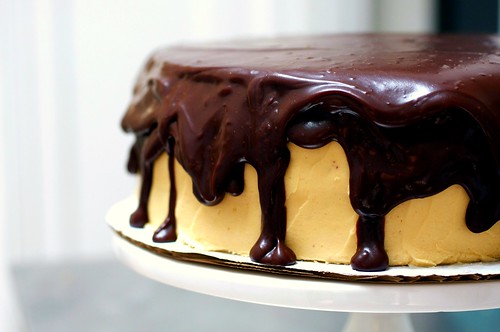
photo via
I have long been puzzled by the phrase, " you can't have your cake and eat it, too." While I knew what people were getting at when they used this phrase, it didn't make much logical sense to me. If I'm going to be able to eat the cake, I will have to have it first. And if I can't have the cake, how could I possibly eat it.
I finally broke down and investigated the origin of this phrase.
According to the sources that be at Wikipedia, the phrase actually indicates the impossibility of
consuming a thing while also managing to conserve it. The phrase may also be used to point out the flaw in wanting to have two irreconcilable things or having two incompatible feelings. Phrases with similar meanings include, "you can't have the best of both worlds" and "you can't have it both ways."
Wikipedia also has this to say about the origin and history of the phrase:
"The phrase's earliest recording is from 1546 as "wolde you bothe eate your cake, and have your cake?" (John Heywood's "A Dialogue Containing the Number in Effect of All the Proverbs in the English Tongue").[1] This phrase alludes to the impossibility of eating your cake and still having it afterwards. The modern version (where the clauses are reversed) is a corruption which was first signaled in 1812. Further misconception has been perpetuated in main-stream media by Douglas Pace during his argument that it is in fact the order of the eating and having which matters, similar to the chicken and the egg conundrum."
Also, if you are wondering how to make (and eat) the delicious cake above, you can find the recipe here.
Subscribe to:
Posts (Atom)